⚡ Quick answer
A website isn't a magnet. It's the home base in a loop. Building one doesn't automatically bring people. You need three roles, each doing a different job:
Wire these three into a loop, reach → home base → close → and back again, and traffic finally flows in, converts, and returns.
Over the last two posts I made two arguments: social media alone isn't enough, and WhatsApp alone isn't enough. A few of you took the advice, built the website, and then messaged me, a little frustrated: "Ah Shuang, I've got social media, I've got the website, I've got WhatsApp. So why is still nobody coming?"
I get this question a lot, and the answer is almost always the same. You don't have a tool problem. You have a connection problem. You're running three separate islands, when they're supposed to be one circuit.
A website doesn't sell because it's pretty. It sells because something keeps sending people to it, and something else catches them when they arrive. Build the site and stop there, and you've opened a beautiful shop in an alley nobody walks down.
01Why "build it and they will come" is a myth
Short version: a website's job is to catch and convert traffic, not to create it. It's brilliant at holding everything in one place, getting found on Google, being quoted by AI, showing your work, and turning a curious visitor into a confident buyer. But it doesn't go out and drag people in by itself.
That's the part people skip. They picture the website as a billboard on a highway: put it up, and cars drive past all day. It's actually more like your shop: the location matters, the window display matters, but if no road leads to it, the nicest interior in town stays empty.
02Three tools, three different jobs
The reason it feels like nothing works is that you're asking one tool to do all three jobs, and no single one of them can. Each has a lane it's great at, and a lane it's terrible at:
- Social media is great at reach, bad at memory. It puts you in front of strangers daily, but the post scrolls away in hours and the platform owns the audience, not you.
- The website is great at trust and being found, bad at reaching out. It's the only piece you actually own, it ranks on Google, it gets cited by AI, but it just sits there waiting; it won't knock on doors.
- WhatsApp is great at closing, bad at being discovered. One-to-one, it's where doubts get answered and deals get done, but nobody finds you by searching WhatsApp; they have to be sent there first.
See it? Each one's weakness is exactly another one's strength. That's not a coincidence. It's the whole point. They're designed to hand off to each other.
03So where do most people get stuck? Three islands
When I look at a business that "has everything but no customers," I almost always find the same three broken handoffs:
- The posts go out, but lead nowhere. The bio link is empty (or points at the IG profile itself), captions never invite a click. The reach happens, then evaporates, no one is sent anywhere.
- The website is built, and then abandoned. It sits there quietly with zero channels pointing into it, and no SEO so search can't find it either. A lovely shop in an empty alley.
- The chat dies halfway. A customer messages, half-decides, goes quiet, and you have no website, no content, nothing to send them that keeps warming them up. The lead just cools and disappears.
Each island, on its own, looks fine. You posted. You have a site. You reply fast. But because nothing connects them, every bit of effort leaks out the gap before it turns into a customer.
Not sure which handoff is leaking in your setup? Spend 5 minutes on WhatsApp walking me through how a customer reaches you today. I'll tell you straight which link is broken and which to fix first. Free, no sales pitch.
💬 WhatsApp us →04What the loop actually looks like
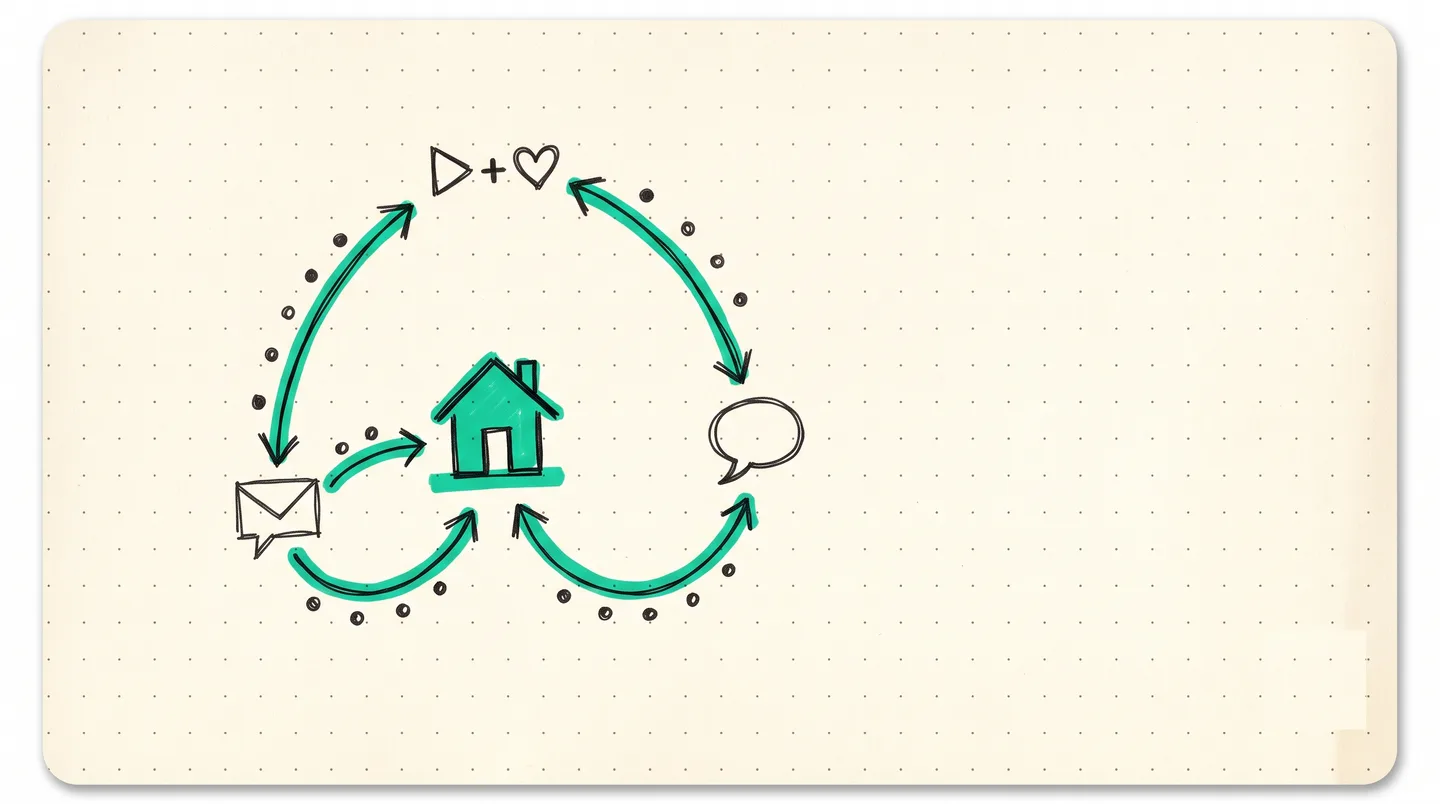
A working setup has two ways in and one way around. Picture it as a circle:
- Push (you reach out): you post on social → someone interested taps your link → lands on your website, reads the details, sees your work, starts to trust you → taps WhatsApp to ask → you close.
- Pull (they come to you): someone Googles "aircon repair PJ" or asks an AI "where to make a website in KL" → because your site has SEO and is AI-readable, you get found / cited → they land on your website → tap WhatsApp → you close.
- Then it comes back around: after the sale, you nudge the happy customer to leave a Google review and follow your Xiaohongshu. That review and that follow become fresh social proof and search trust, which brings in the next stranger. The loop closes.
That last step is what separates a loop from a funnel. A funnel pours out the bottom and you start over. A loop feeds its own top. Every customer you close makes the next one slightly easier to reach. That's how small businesses compound instead of starting from zero every month.
05How to actually wire it up
You don't need more tools. You need five small connections between the ones you already have:
- Put your website link in every social bio. Xiaohongshu only allows one link: use a focused landing page for it, not your homepage, so that single click goes somewhere that converts.
- Put a visible WhatsApp button on every page of the site. Don't make a warmed-up visitor hunt for how to talk to you: the handoff to closing should be one tap away, everywhere.
- Give the site basic SEO + make it AI-readable (GEO). This is what opens the "pull" door, without it, search and AI engines can't send anyone in, and you're left with only the "push" you have to power by hand.
- After you close, ask one sentence: "If it's not too much trouble, could you leave me a Google review / follow my Xiaohongshu?" That single line is what bends the funnel back into a loop.
- Use UTM links + Google Analytics to see which channel actually brings people. This is the exact thing you can't do on WhatsApp alone. I covered why in the WhatsApp post. Once you can see it, you stop guessing and double down on what works.
06No time to post every day? Run the minimum viable loop
Most small business owners I talk to are also the cook, the cashier and the delivery guy. You don't have time to be a content machine, and you don't have to be. The loop still works on a tiny budget of effort:
- Website = your always-on home base. Build it once; it keeps getting found in search 24/7. This is the "pull" door, and it needs zero daily attention.
- Social = one or two posts a week is fine. The point isn't volume. It's that every post carries the website link, so the reach you do get always has somewhere to go.
- WhatsApp = turn every closed chat into a review. You're already talking to them anyway; one extra sentence feeds the loop.
The win isn't posting more. It's making sure there's a wire between all three points, so none of them is a dead end. A small loop that's actually connected beats three busy islands that aren't. Every time.
One more thing, since people always ask: every site I build comes with WhatsApp integration, basic SEO and Google Analytics as standard. I.e. the wiring above is built in, not an add-on. If you're still weighing which tier of website you even need first, I broke that down by industry in this post.
The whole thing, in one line
A website was never a signboard that glows the moment you put it up. It's the home base in a loop. Connect reach, home base and closing into a circle, and customers stop trickling. They start flowing in, and coming back.
